Why does my cat get the zoomies at night?
Cat behavior · The Zoomies
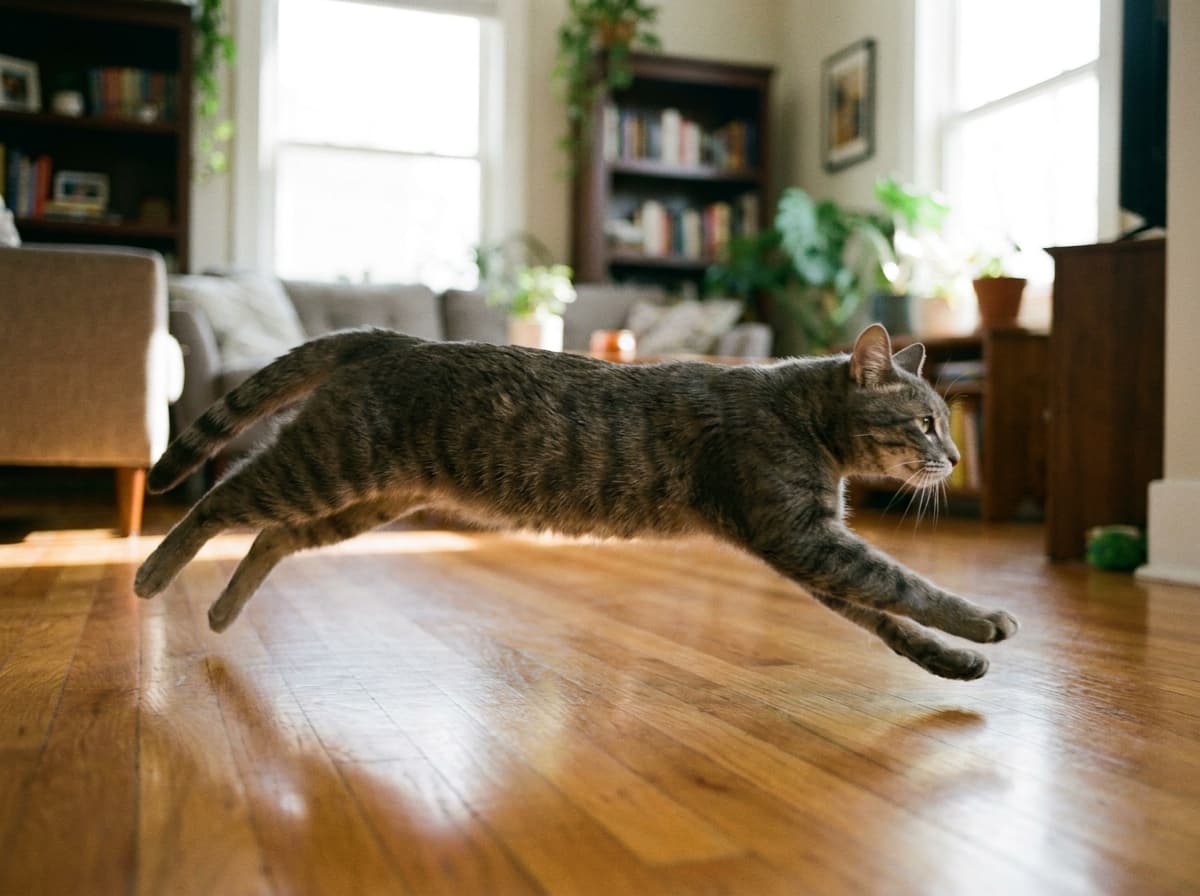
Your cat suddenly tears through the house at full speed, often in the middle of the night, then stops abruptly and resumes normal behavior. This is called the "zoomies" or "FRAPs" (Frenetic Random Activity Periods). What's the BEST explanation?
Pawclue turns this into a 10-second daily guess — play today's.
Discharging pent-up predatory and play energy — normal in indoor cats
What it actually means
FRAPs are the cat's way of discharging accumulated predatory drive — they're crepuscular hunters whose energy peaks at dawn and dusk, but indoor cats have no real prey to hunt. The energy has to go somewhere. Night zoomies are particularly common in young cats and after litter-box use (post-elimination dash is well-documented).
Your cat is dozing one minute and then, with no warning, tearing through the house at full tilt, ricocheting off furniture, thundering up and down the hallway, often at two or three in the morning. Then, just as suddenly, it stops, sits down, and goes back to grooming like nothing happened. These bursts have a nickname, the "zoomies," and a more formal name, FRAPs, for Frenetic Random Activity Periods.
The leading explanation is that zoomies are how a cat discharges pent-up energy, especially predatory and play energy that has nowhere to go. Cats are crepuscular, naturally most active around dawn and dusk, which is when wild cats would be hunting. Indoor cats have that same energy peak but no actual prey to chase, so it builds up and then erupts as a sprint. That's why the timing so often lands in the early morning or late evening, it tracks the cat's built-in activity clock. There's also a well-known "post-poop" version, a dash right after using the litter box, which is common and generally nothing to worry about.
In a healthy, well-exercised cat, zoomies are completely normal and even a good sign of a cat that feels safe and full of beans. The misreads run in two directions: some owners panic that the cat is having a seizure or a mental break, while others ignore frequent, frantic zoomies that are really a sign the cat is bored and under-stimulated. A true zoomie is brief, coordinated, and the cat snaps back to normal instantly, very different from the repetitive, unresponsive movements of a seizure.
The fix for too-frequent or middle-of-the-night zoomies is to drain that energy on purpose before it goes off on its own schedule. A vigorous wand-toy session in the evening, letting your cat stalk, chase, and actually "catch" the toy, followed by a meal, mimics the natural hunt-catch-eat cycle and tends to leave cats satisfied and ready to settle. Puzzle feeders help too. If the zoomies come with signs of genuine distress, sudden aggression, disorientation, vocalizing in pain, or in an older cat that's suddenly hyperactive and losing weight (which can point to thyroid issues), that's worth a vet visit, but the everyday 3am sprint is usually just a cat being a cat.
What to do
Schedule a vigorous wand-toy play session before bed. Cats need both the hunt sequence (stalk → chase → grab) AND a "kill" (catch) AND a "consume" (food after play) for the cycle to feel complete. Without it, energy bleeds into 3am zoomies.
Test your knowledge
Your cat suddenly tears through the house at full speed, often in the middle of the night, then stops abruptly and resumes normal behavior. This is called the "zoomies" or "FRAPs" (Frenetic Random Activity Periods). What's the BEST explanation?
- Mental illness or a seizure
- Discharging pent-up predatory and play energy — normal in indoor cats✓ correct
- Fleeing a perceived threat
- Stomach pain from food
Pawclue turns one pet behavior into a 10-second daily guess — free, no signup.
Play today's puzzle →